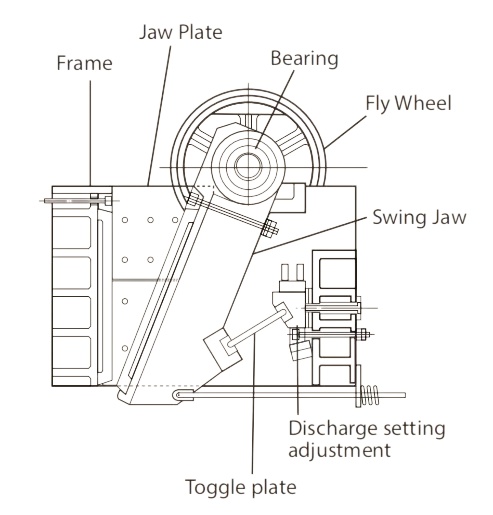
The jaw crusher mainly comprises a movable jaw, a stationary jaw, and a crushing chamber. The movable jaw, when working, makes a forward (reciprocating) movement, which crushes the material that is introduced into the crushing chamber.
Linear Movement of the Rotating Jaw:
As the crusher is activated, the moving jaw (typically powered by an electric motor) commences a type of reciprocating action, moving forward and backward along a predetermined path.
When the moving jaw is facing forward, it approaches the fixed jaw, and the material in the crushing chamber is squeezed and crushed.
During the opposite motion, the moving jaw moves away, leaving space in time to allow the next material to enter.
Up and Down Movements of the Moving Jaw:
In the raising phase (upward movement), the distance between the moving and the fixed jaw increases, and the material flows into the crushing chamber without trouble.
Then, in the downward movement (pressing), the moving jaw is pushed downwards, and the material is squeezed and crushed between the two jaws.
Compression and Crushing:
The moving jaw, as it moves back and forth, folds and crushes the material in the crushing chamber several times. The force on the jaws breaks the material into smaller pieces as it progresses.
Material Discharge:
After the material has been crushed into the required size, the material is then released via an outlet at the bottom of the crushing chamber.
Why does the moving jaw of a jaw crusher fracture?
a. The castings of the moving jaw have serious defects, such as dense air holes or slag inclusions, which result in insufficient material strength. Under high-intensity impact, the moving jaw is prone to fracture.
b. The equipment has been running in overload for a long period, or hard materials or non-crushing materials enter the crushing chamber. The toggle plate protection fails to act promptly, causing the moving jaw to bear excessive impact and eventually fracture.
c. When the moving jaw shifts inside the frame and collides with the liner, or if the tension spring fails and has not been replaced, or if the toggle plate/toggle plate pads are of poor quality, stress concentration will intensify and lead to fracture.
d. Improper operation by workers, such as suddenly increasing the feed rate, uneven feeding, or feeding unqualified hard materials, causes the equipment to overload instantly. Failure to replace the ineffective tension spring in time, or the shifting of the moving jaw assembly, or using substandard toggle plates, results in failure of the self-disconnection protection and collision wear of the parts, ultimately causing the moving jaw to fracture.
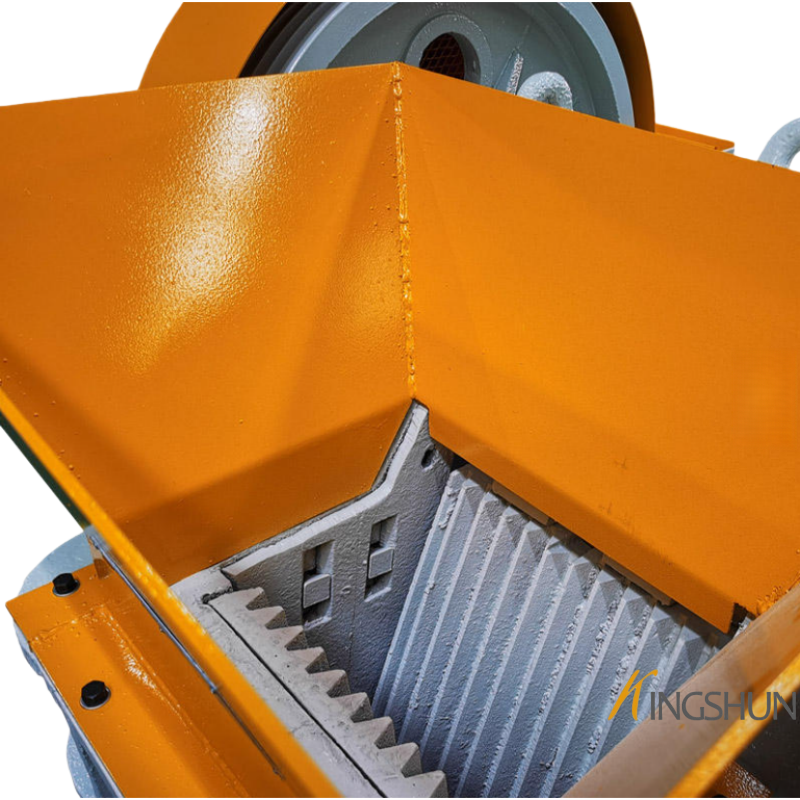 What is the method to identify wear of the jaw plates when operating?
Please take a look at my other news article.
How to Consider Jaw Plate Wear in Adjustment (kingshunsplitters.com)

